Love on the Dole
(1940)


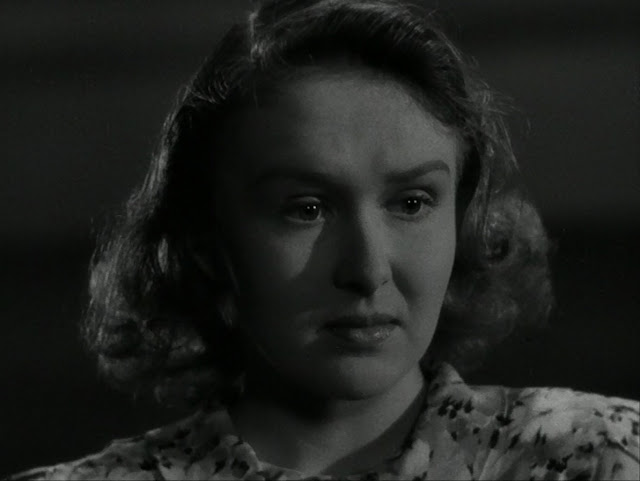
... then there are the two children, factory girl Sally (Deborah Kerr in her second film and her first starring role) ...

... and factory apprentice Harry (Geoffrey Hibbert):

Harry has a girlfriend Helen (Joyce Howard) who endures a sad life as the daughter of drunken parents whose arguing, fighting and loud sex dominates her world.
Sally Hardcastle is the object of affection for many of the men in the area, yet gives her heart to Larry Meath (Clifford Evans) an industrially and politically aspirational man. He's an outsider, a Welshman who works hard both to better himself and to improve the lives of those he lives among. As a forward-thinking young engineer, it's a type that Evans played again in The Foreman Went to France three years later.
 |
| Clifford Evans & Deborah Kerr |
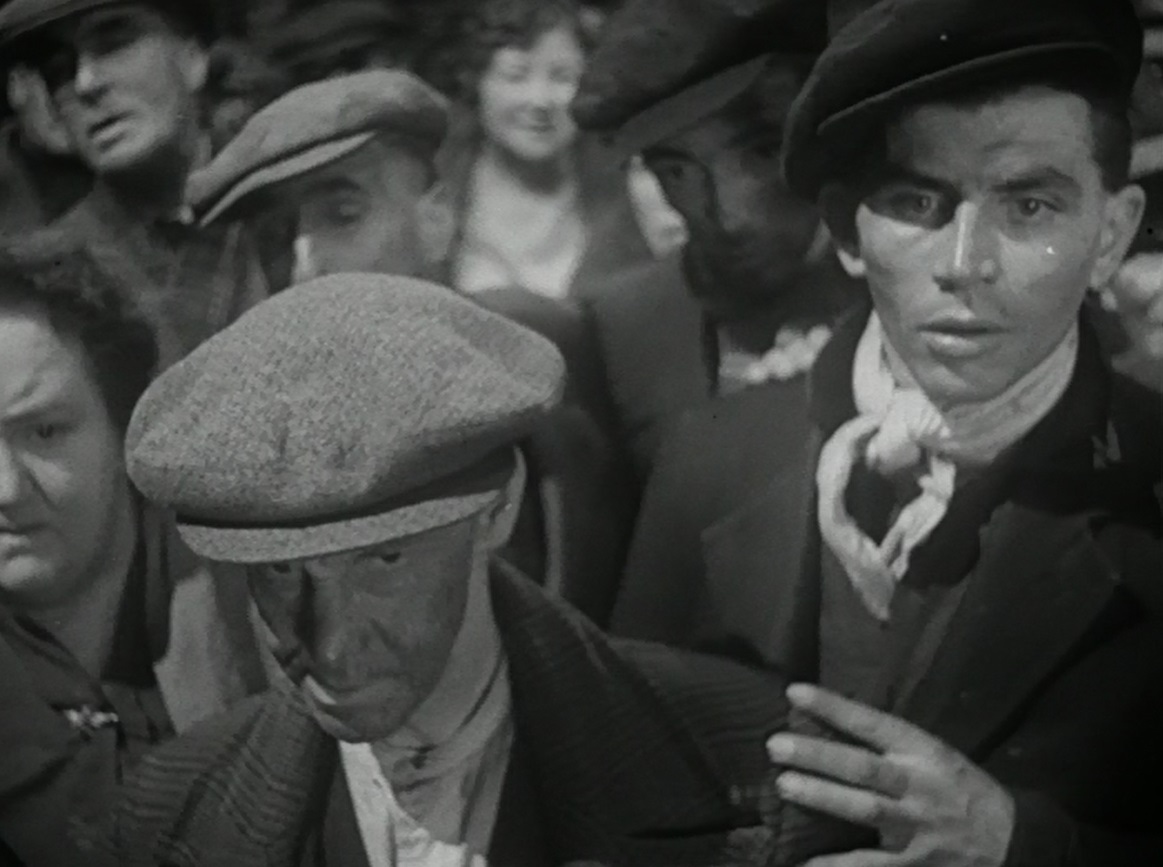

Central to both book and film is the story of Harry
Hardcastle’s (Geoffrey Hibbert) suit. Both book and film open with scenes set in a pawnbroker’s
shop as local women queue to bring in the suits belonging to their sons, husbands and lodgers:

The message is clear: for the working man, suits are only for weekends. Taken out of ‘hock’ on payday, then returned after the brief day and a half interlude of leisure, the suit is the thing of dreams. In the book Greenwood devotes the entirety of chapter 4 to Harry’s dreams of finally acquiring a suit. He wants: “A new suit; a proper new suit; one made to special measurements, shaped at the waist, not a reach-me-down that fitted like a sack.” He imagines himself wearing blue serge that “embraced him, creaseless, precise.”
"The question of a new suit became an obsession. He dreamed on it; wore it so often in fancy that, on waking of a Sunday morning, he was fully convinced that it hung behind the bedroom’s curtained-off alcove which served as a wardrobe. It wasn’t there. What met his eyes when he opened them was grim reality decorating the bed-end, those wretche reach-me-downs bought second-hand from an auction at the Flat Iron Market. Sulkily he would rise.”

The message is clear: for the working man, suits are only for weekends. Taken out of ‘hock’ on payday, then returned after the brief day and a half interlude of leisure, the suit is the thing of dreams. In the book Greenwood devotes the entirety of chapter 4 to Harry’s dreams of finally acquiring a suit. He wants: “A new suit; a proper new suit; one made to special measurements, shaped at the waist, not a reach-me-down that fitted like a sack.” He imagines himself wearing blue serge that “embraced him, creaseless, precise.”
"The question of a new suit became an obsession. He dreamed on it; wore it so often in fancy that, on waking of a Sunday morning, he was fully convinced that it hung behind the bedroom’s curtained-off alcove which served as a wardrobe. It wasn’t there. What met his eyes when he opened them was grim reality decorating the bed-end, those wretche reach-me-downs bought second-hand from an auction at the Flat Iron Market. Sulkily he would rise.”
“Please God let th’ old man get me that there suit. Ah ain’t
ne’er had a proper un.”
This pursuit of a modern three-piece suit is all-consuming: for
Harry it was a giant leap to move from a shop job, where he was still dressed
as a child, to the factory where he was among men and dressed the part –
complete with the working-class uniform of flat cap and where mercerised cotton
scarf. Greenwood’s novel makes a number of references to Harry’s white scarf:
by referring to it as being mercerised cotton (a process in which the cotton is
treated to reduce creasing, giving it a sheen making the scarf appear almost
silk like) the reader is forced to understand that silk is beyond the means of
Harry and his like: |
| Geoffrey Hibbert |
When Harry is finally able to purchase a new suit it is only through the assistance of his mother who finally agrees to make a hire-purchase arrangement with a clothing club. To get a suit he needs to give his father’s occupation, length of tenancy at their home, name and address of his employers, how long he had worked there and in what position. Then they need to show rent and insurance books to prove the family are regular payers ...

... meaning that for three shillings down, then three shillings a week for twenty weeks, his dream can finally be realised and the £3 made-to-measure suit can be finally be purchased.
In the book the reader is left to visualise the suit for themselves, yet film – as a visual medium – has to offer the viewer a this suit as a thing of wonder. Where words convey the sense of longer and the impact something as simple as buying clothes can have on a young man dreaming of a better future, in cinema it is necessary for a visual presentation of the suit. Interestingly, Greenwood makes no description of the suit itself, which is strange considering his emphasis on Harry’s scarf and the fact that it is a particular type of cotton. On screen his suit is a thing of wonder - broad shouldered, neatly ‘wasp waisted’, with multi-stripes, wide peak lapels, a fancy double-breasted waistcoat and wide trousers – it instantly sets him apart from his peers. It is modern, elegant and stylish, something that makes an immediate impact on the drab streets of his hometown.


In a nice visual gag, we see Harry take his girlfriend Helen (Joyce Howard) ...
... out onto the nearby hills. It's a place of escape from the dark and dingy city streets, where the people can engage with the natural world - other than dogs, pigeons and rats. When Harry lays down his handkerchief Helen thinks he has put it there to protect her from the damp earth - but no, it's to protect his beloved suit.

In the scenes when Harry goes to Blackpool with Helen, the film's costume designer gives him the perfect jacket for a young man in the 1930s who has just come into some money: a belt-back sports jacket:


Visually, the desperate pride that Harry takes in his suit, and his firm understanding of the sacrifices needed to be so well dressed, is contrasted to the way in which the film’s ‘wide boys’ and criminals are presented. Their fine clothes, and the ‘flash’ way their outfits are put together, introduce us to a word where the suit is a week-long badge of status within the community, not just something to be worn between Saturday lunchtime and Sunday night.
The outfit worn by local bookmaker, Sam Grundy, is described by Greenwood in detail: “… a small fat man, broad set, with beady eyes, an apoplectic complexion … thumbs in his waistcoat pockets ...
... Preposterous-sized diamonds ornamented his thick fingers ...
... and a cable-like gold guard, further
enhanced by a collection of gold pendants, spade guineas and Masonic emblems,
hung heavily across his prominent stomach ...
... He chewed a match stalk; his
billycock rested on the back of his head; he wore spats. Self-confidence and gross
prosperity oozed from him.”
The suit worn by Sam's assistant (Philip Godfrey) is another cinematic 'wide boy' standard:


It's almost identical to the suit worn by Jack Livesey in 'Penny Paradise' and Sonnie Hale in 'The Gaunt Stranger'.
Also appearing are:
Love on the Dole is a film that, on its release had challenged audiences and yet has been largely forgotten, unlike its source novel that remains standard reading for anyone interested in 20th Century British working class literature. So its good to see the film available once more (i.e. you should buy the DVD):


... out onto the nearby hills. It's a place of escape from the dark and dingy city streets, where the people can engage with the natural world - other than dogs, pigeons and rats. When Harry lays down his handkerchief Helen thinks he has put it there to protect her from the damp earth - but no, it's to protect his beloved suit.

In the scenes when Harry goes to Blackpool with Helen, the film's costume designer gives him the perfect jacket for a young man in the 1930s who has just come into some money: a belt-back sports jacket:


Visually, the desperate pride that Harry takes in his suit, and his firm understanding of the sacrifices needed to be so well dressed, is contrasted to the way in which the film’s ‘wide boys’ and criminals are presented. Their fine clothes, and the ‘flash’ way their outfits are put together, introduce us to a word where the suit is a week-long badge of status within the community, not just something to be worn between Saturday lunchtime and Sunday night.
The outfit worn by local bookmaker, Sam Grundy, is described by Greenwood in detail: “… a small fat man, broad set, with beady eyes, an apoplectic complexion … thumbs in his waistcoat pockets ...
 |
| Geoffrey Hibbert & Frank Cellier |
... Preposterous-sized diamonds ornamented his thick fingers ...
 |
| Geoffrey Hibbert & Frank Cellier |
 |
| Frank Cellier |


Also appearing are:
 |
| Charles Williams |
 |
| John Slater |
 |
| Mike Johnson |
 |
| Kenneth Griffith (centre) |
 |
| Yvonne Mitchell (right) |


