Sunday, 6 April 2014

Death at Broadcasting House (1934)


This is one of those 1930s oddities that makes the viewer wonder how it ever got to be made. Not that it's a bad film (far from it, I rather enjoyed it) but it must have been an odd meeting where this one was pitched to the producer:
"Hello, I'm a radio producer at the BBC, I've written a murder mystery set at the BBC's lovely new central London studios."
 
"Why would I be interested in that?"
 
"Well, the wireless is getting very popular these days. Think of it, I'll fill the film with all their favourite radio stars and presenters, throw in a few songs and even give them a mystery story on top."
 
"Sold!"
 
The writer in question was Val Gielgud (brother of John Gielgud), who was working as the BBC's Head of Production at the time. The resulting film really should be available in a box set along with The Arsenal Stadium Mystery, another thirties film that offers a murder mystery filmed in a familiar location. Although the filming wasn't actually done on location, due to the size of the rooms within Broadcasting House, the sets were an accurate representation of the studios and control rooms, thus giving the viewer an idea of the workings of the BBC at the time. It's like a better dressed, better mannered, version of  reality television!  With murder.
 
Donald Wolfitt


Even the sound effects staff get a look-in:

 
Since I don't want to give away the plot, I won't say much except that an unpopular actor is actually murdered in the middle of a scene in which he is supposed to be acting his own murder. The cast and crew all fall under suspicion, revealing a murky world of  rivalry and secret relationships .... plus ca change!! 
 
In the studio scenes we see the BBC dancers ...
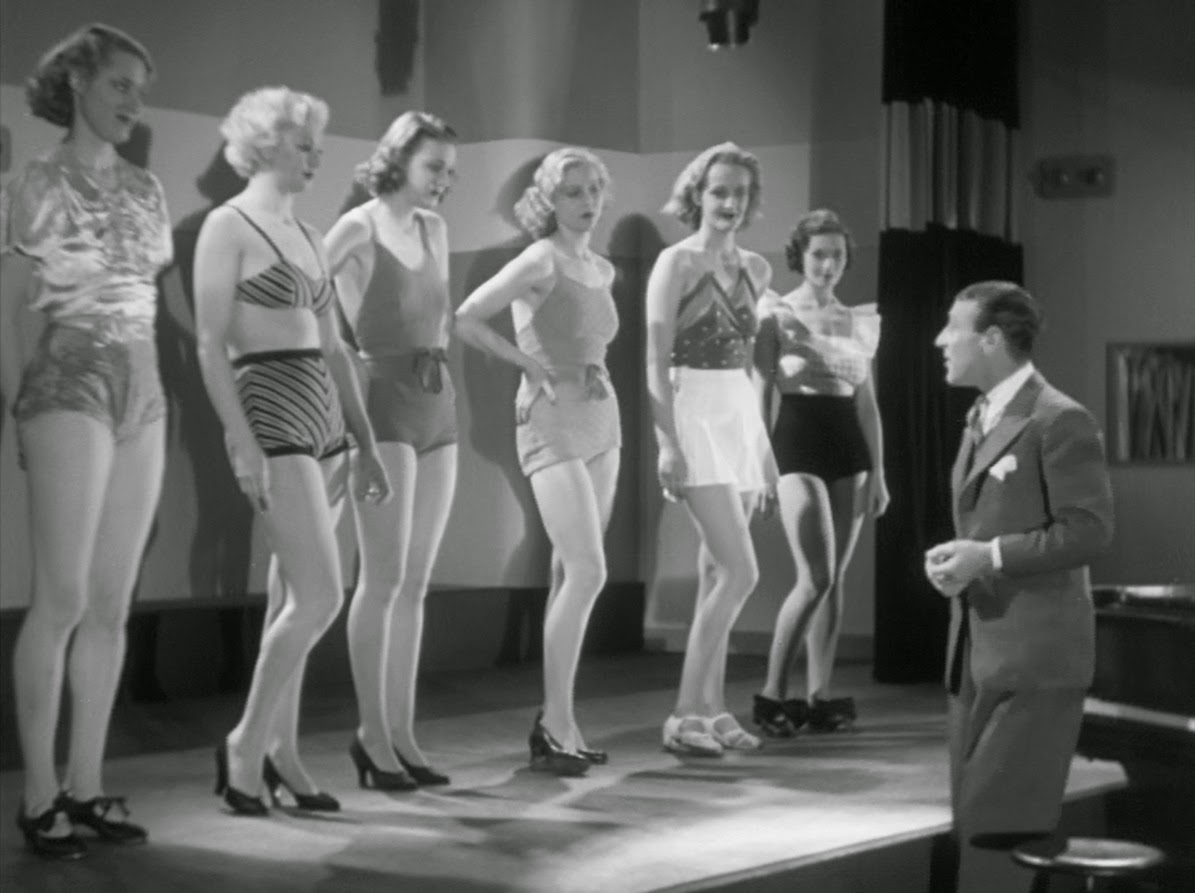


... I suppose these were the Pan's People of their day. I almost expected to see Jimmy Saville creeping around them, trying to cop a feel.
 
Elsewhere we are treated to stars of the period:
Elisabeth Welch

Eve Becke

Gillie Potter

Hannen Swaffer

Percival Mackey

Vernon Barlett
The Gershom Parkington Quintette
 
Here's a glimpse of the cast:


Bruce Lester
It's good to see BBC presenter Eric Dunstan appearing as himself, saying Goodnight to listeners as the service closes for the night:

 
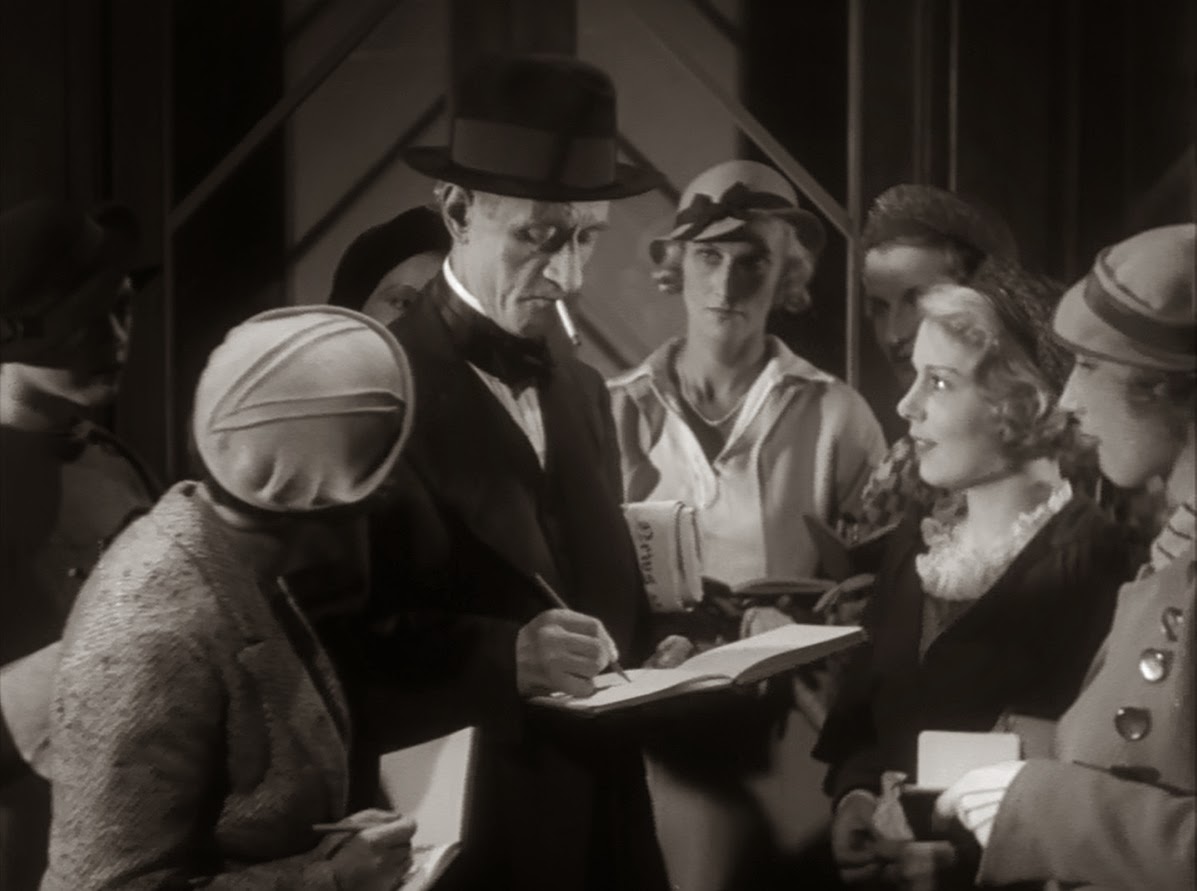
As well as the fact that he is dressed in a dinner suit for a nightly performance that no one sees, I like the way that, as soon as he has spoken the final words of the day's broadcast, he lights up a cigarette.
 
Currently available from the ever-industrious people at Network DVD:


Saturday, 5 April 2014

Hunted (1952)
 
Dirk Bogarde & Jon Whiteley
This is a rather simple, but surprisingly touching story of a young boy Robbie (John Whiteley) who runs away from home, fearing his adoptive parents, and goes on the run with an escaping killer, Chris Lloyd (played by Dirk Bogarde). The film follows their hopeless attempts to get away. As time passes, the bond between the two runaways develops. At first we view Chris as having kidnapped Robbie, then – as we learn more about the boy’s life – we understand why he stays with Chris, who shows him more genuine affection than his parents. This tenderness takes ‘Hunted’ beyond the realms of a simple crime thriller, into the territory of a genuinely provocative and thoughtful film. As the film progresses the audience begins to see the runaways as two outsiders, thrown together by circumstances, with the whole world against them: if apprehended Chris faces prison (and maybe the gallows?) whilst Robbie faces a return to a violent home.
Dirk Bogarde
It’s a morally complex story: should the viewer hate Chris for kidnapping the child or should we hate Robbie’s violent father? Is Chris actually a murderer, or was his crime an accidental crime of passion?
 
That these questions go unanswered, gives the film a depth that is often missing from British crime dramas of the period. Indeed, the ambiguities in the relationships (between Chris and Robbie; between Robbie and his adoptive parents; and between Chris and his unfaithful wife), combined with the bleakness of the scenes of Scottish wilderness in the film’s latter stages, and the uncertainty over the circumstances of the murder, the film brings to mind modern Scandinavian dramas.
And that is something worth celebrating.
John Whiteley, who was not yet seven years old when the film was made, had a high profile as a child star.
Jon Whiteley


His appearance in the 1953 film The Little Kidnappers won him the Academy Juvenile Award, a short-lived award known as the Juvenile Oscar, an award given out between 1935 and 1961. Other winners included Shirley Temple, Mickey Rooney, Judy Garland, Sal Mineo and Hayley Mills. After retiring from the screen in 1957, Whiteley returned to full time schooling and became an art historian. He is currently (2014) a curator at the Ashmolean Museum in Oxford.


Also appearing are:

Grace Arnold


Elizabeth Sellars

Fred Piper

Harry Quashie

Joe Linnane

Julian Somers


Kay Walsh
Geoffrey Keen (left) & Sam Kydd (right)
 
P.S. For any of our younger readers, this scene (smoking chimneys and men on their way to work) might be unfamiliar to you: it's called industry:
 
 
It's currently available on DVD


Thursday, 3 April 2014

Shared Locations:
Hunted (1952) & Dance Hall (1950)
 
Two of director Charles Chrichton's lesser known films, Hunted and Dance Hall are notable not only for their ability to entertain without making a fuss, but also for sharing locations.
 
 
Here we see Petula Clark emerging from her home, on her way to the Dance Hall:
 
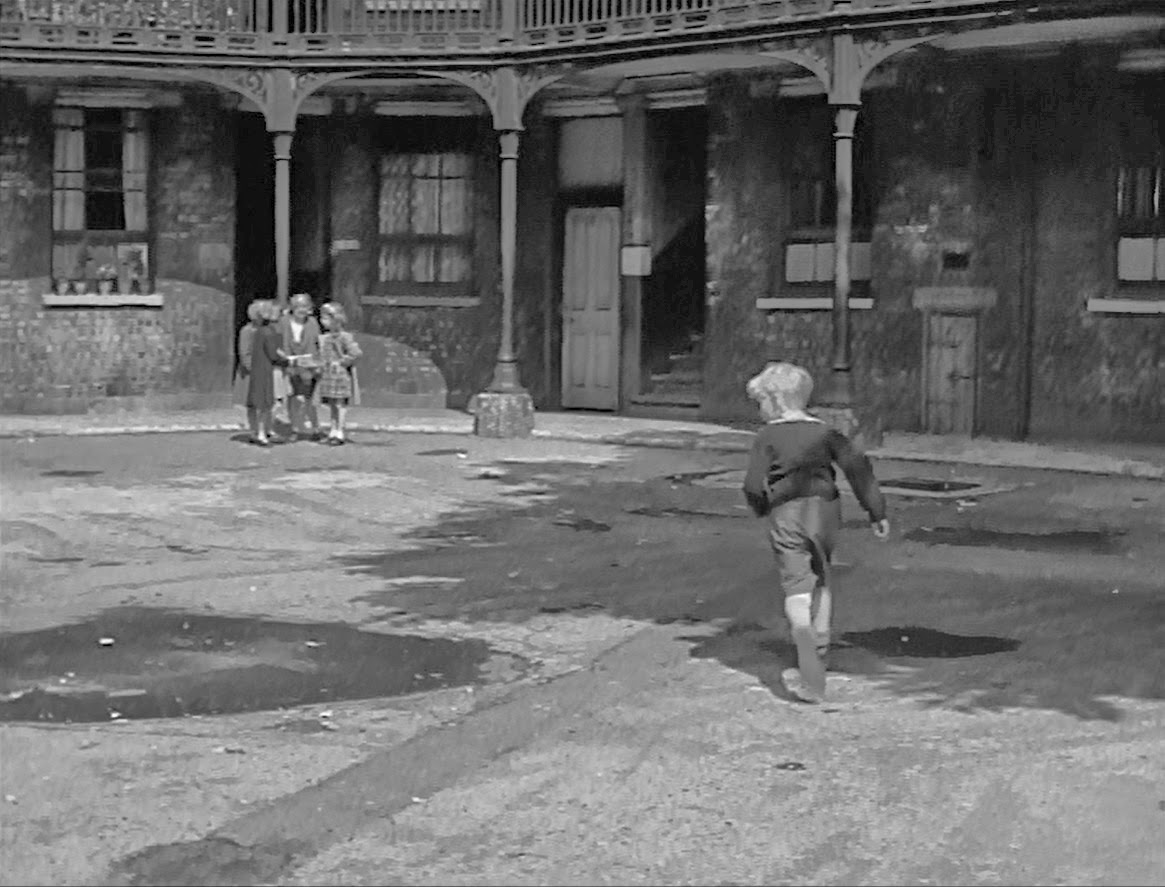
And here's the same flats featuring as the home to Dirk Bogarde in Hunted:


The flats stood near Buckingham Palace Road in London, opposite the BOAC Terminal, which can be glimpsed over Dirk Bogarde's shoulder:


Looking at an old map, I found that there was a Flask Lane leading into Buckingham Palace Road, just opposite the BOAC Terminal. The map even shows the turn in the road that can be seen beyond Bogarde. If I am correct, the arched doorway is the entrance to the church shown on the map:

This map (showing WW2 bomb damage in the area) gives us the name Ebury Buildings:

I think we can safely conclude that the flats seen in the films ...
 
... are the Ebury Buildings, built for artisans in the 1870s and shown in this 19th Century photograph:
Copyright to Bridgeman Art Library (http://www.bridgemanart.com/en-GB/search/keyword/ebury+buildings#loginGoadModalWindow)
A bit of internet digging also reveals that Michael Parkinson was born in the flats.
 
 
I believe the police car is  entering from Semley Place and we can see Ebury Square in the background. The buildings on the left, covered in scaffolding, are the parts of Ebury Buildings shown on the map in pink i.e. badly damaged are due for demolition). The view below suggests the demolition may have been underway.  

This shot from Dance Hall shows Donald Houston leaving Ebury Buildings from the same exit and heading towards Ebury Square. The workmen in the gardens are most likely repairing the damage done by the V1 flying bomb that landed there (as circles on the bomb damage map):


Incidently, the woman in this picture above is Grace Arnold (whose character arrives at the flats just after Bogarde) ...
Grace Arnold
... who also played a character living in these flats in Dance Hall.
Grace Arnold
 Later in Dance Hall we see cyclists coming past All Saints Church. This formerly stood on Grosvenor Road in London, almost directly across the Thames from Battersea Power Station:
 
The street on the right is Rutland Street (later renamed Antrobus Street), long since demolished to make way for the Churchill Gardens estate. A block named Darwin House stands roughly where the church once stood.
 
 
In this next photo we see Donald Houston with the same truck that is in the background in the previous shot. In the distance are the bridge taking trains into Victoria Station and, beyond that, the suspension pillars of Chelsea Bridge are visible.


Here's the same location in Hunted:
 
 
The motorcycle is in front of a wall. I believe this shields the old Belgrave Dock.
 
 
Here's a view in the opposite direction along Grosvenor Road. On the left are what I believe to be the engine works which stood between Antrobus Street/Rutland Street and Ranelagh Road. Research indicates that the works were bombed during World War 2, leading to the derelict state we see above.