Monday, 22 June 2015


Freedom Radio (1941)
Derek Farr & Clive Brook
 
Director Anthony Asquith’s 1941 film Freedom Radio is a fine example of British cinema’s attempts to quickly and cheaply remind the world of the truth about life under the Nazis. Set in 1939, just before the German invasion of Poland and the outbreak of war, it tells the story of a dentist Dr Karl Roder (Clive Brook) who starts to see how the realities of Nazi rule personally affect him.
Clive Brook
 
At first he enjoys the patronage of Hitler, treating his teeth and enjoying the benefits of such links, but slowly he sees the realities of totalitarianism creep into his world. His drinking club for old university friends is closed, then his friend Father Landbach (Morland Graham) ...
 
... is beaten and arrested for preaching against Hitler. These scenes help to remind viewers that it was not only the Jews and the communists who felt the full force of oppression, showing how the safety and security of middle-class life were also being eroded. One has to wonder whether the intention was to convince the British middle-classes, elements of which had previously been sympathetic towards fascism, to abandon any thoughts that life under German occupation could be tolerable and might be compatible with their own lifestyle.

Dr Roder’s personal position is made difficult by his wife’s position within society.
Diana Wynard & Clive Brook
Frau Irena Roder (Diana Wynard) is a leading actress known for her traditional Germanic roles and, as such, is an obvious favourite of the Nazis. With her promotion to the position of the Reich’s ‘Director of Popular Plays and Pagentry’ ...
Diana Wynard
... Dr Roder finds himself trapped between his personal sense of morality and his loyalty to his wife. That her younger brother Otto (John Penrose) is also an enthusiastic member of the SS doesn’t help Roder’s sense of isolation.
Diana Wynard & John Penrose
 
Roder is offered a way to escape this feeling of frustration by a chance meeting with Hans Glaser (Derek Farr) ...
Derek Farr
... a young radio repairman whose career has been frustrated by his refusal to follow the Nazis. When Glaser’s girlfriend Elly Schmidt (Joyce Howard – who later retired from acting, moved to Hollywood, and became an executive with Paramount TV) ...
Joyce Howard
... is denounced by a neighbour (Martita Hunt, who portrays the pure embodiment of evil) …

Martita Hunt
… raped, then arrested by an SS officer (Manning Whiley) ... 
Manning Whiley
... before being sent to a ‘rest camp’, he decides it is time to tell the truth about the regime. The two men join forces to set up a pirate radio station which broadcasts the truth behind the Nazi prpaganda … all the time with the net closing in around them.

 
Although unseen apart from in stock footage and the inevitable framed images on every wall, Hitler hangs over the film like some ominous spectre that haunts all of their lives: Frau Roder is seduced by the success the Fuhrer can bring to her artistic career; her brother by glamour and activity. On the opposite side of the political lines, Elly and Hans are haunted by her rape whilst Dr Roder and his friends see Hitler as the force that has stripped away all of the morality that had nurtured their personal development. For them, there is no escape from Hitler and the forces that he has gathered around him. Despite their desires to simply get on with their lives, they are forced to fight back to see if they can pull back the shadow that hangs over them.

By bringing together the ordinary people of Germany (a dentist, a radio engineer, a music hall performer, a clergyman, waiters and old ladies) and identifying them as the enemies of Nazism and heroes in the struggle, the film has both an internationalist message and offers  theses characters as the ‘everyman’ (and, course, ‘everywoman’). They are all capable of playing a role in trying to defeat the Nazis and, although the characters behind ‘Freedom Radio’ fail to prevent the outbreak of war, they stand to inspire those similarly ordinary people, from all around the world, whose steadfastness was needed to prevent a Nazi victory. Freedom Radio may not be the greatest war film ever made – nor even in the top 100 – but it’s a fascinating propaganda piece with an important, and genuine, message.

The cast also includes numerous familiar faces in small roles:

Raymond Huntley:
 

Katie Johnson:
 

William Hartnell:
 

Bernard Miles:
 

Clifford Evans:
 

Hay Petrie:
 

Joan Hickson:
 

Abraham Sofaer:
 

Reginald Beckwith:
 
Mike Johnson (left):

Currently available on DVD:


Tuesday, 26 May 2015

Brothers in Law (1957)
 
Ian Carmichael
If there's a British comedy of the 1950s that you haven't seen, but really should see, then it is Brothers in Law. This 1957 Boulting Brothers film is a much underrated, and under-seen, film that follows the courtroom adventures of Roger Thursby (Ian Carmichael), a newly qualified barrister, as he struggles to build a career. Based on the novels of barrister Henry Cecil (you should try to find them, they are really quite entertaining), the film reveals the struggles of the naïve barrister as he tries to deal with judges who are ignorant of the law, witnesses who are afraid to tell the truth, plaintiffs with little grasp on the truth and the general speed with which the majority of court cases are conducted - leaving the less experienced barrister with little room to make even the slightest error.
Ian Carmichael
What is so surprising is that Brothers in Law is not as well known as some of Ian Carmichael's other films. Lucky Jim, Private's Progress, School for Scoundrels and I'm Alright Jack all come from the same period and feature Ian Carmichael as the hapless innocent, a nice (but not dim) guy who is thrown into a world where he is surrounded, and exploited, by those more worldly wise. Yet Brothers in Law stands alone with perhaps more charm than some of those other films.
 
The real stand-out performance is from Terry-Thomas playing a low level con man who chooses Roger to defend him. Terry-Thomas appears with Carmichael in all the films listed above, yet is only here that he strays out of character. Instead of playing the smooth, charming, but corrupt, womaniser - your archetypal cad - he plays a wide-boy, an unashamed criminal. There's no trace of the refined accent that Terry-Thomas had worked so hard on to conceal his real voice. Instead we perhaps get an indication of his original voice.
Terry-Thomas

Terry-Thomas and Ian Carmichael
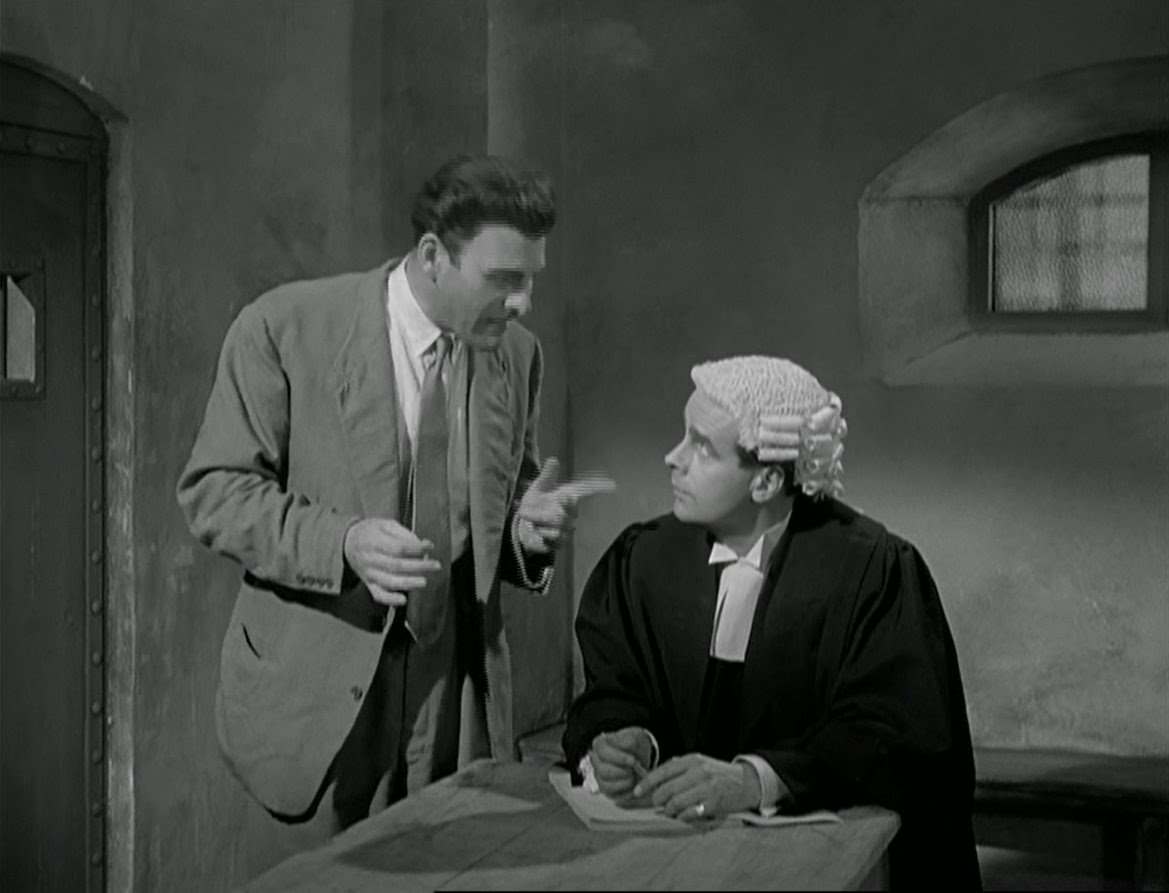
And, unlike those previous films, Terry-Thomas doesn't pit himself against Carmichael. Instead he helps him to win his first case, although he does have to lead the confused barrister through every step of the proceedings. It's a revelation to see Terry-Thomas in a crumpled suit and shiny tie rather than his more usual finery. His cigarette clenched between thumb and forefinger is a far-cry from the cigarette holders we more normally associate with him.
 
No less pivotal is the performance of Miles Malleson as Mr Grimes, the barrister who takes Thursby on as a pupil. He is a comic dream - forgetful, wig-wearing, talking virtual nonsense to judges - his finest moment is arriving in chambers one morning to remove endless layers of clothing. The sequence passes without comment but has an indelible comic charm.
Miles Malleson

Miles Malleson
As he begins his appearances in court, Thursby comes up against all manner of obstacles. There's the unmovable judge ...
John Le Mesurier
... the witness who refuses to tell her story to the court ...
Irene Handl
... and the woman seeking a divorce who reveals that her husband actually deserted her due to her infidelities ...
John Boxer and Olive Sloane
All leave Thursby convinced he will never make a living as a barrister:
Ian Carmichael
His big break comes courtesy of a horse-racing case in which a journalist has been accused of slander. Forced to stand in at the last minute, Roger charms the judge (Rolf Lefebvre) and sees his fortunes turn:
Rolf Lefebvre
 
Ian Carmichael and George Rose
During cross-examination, Roger twists and turns to confuse the defendant (George Rose) eventually forcing him to concede. The scene has a genuine comic charm, with Thursby's genuine skills finally shining through. The scenes appeal comes from the choice of the film's oldest, most cadaverous, judge who turns from a nightmarish vision of a hanging judge into a charming old fellow who accepts everything Roger says to him. As a piece of comedy this scene is a match for anything in those other films we earlier listed.
 
Of course, we mustn't forget the obligatory love interest Sally (Jill Adams) who lives in the flat upstairs:
Jill Adams & Ian Carmichael
For all her seeming innocence - the lacy bow blouse and poorly cut fringe - there's something delightfully saucy about her as she sets out to seduce both Roger and his flatmate (Richard Attenborough). Oh, and of course, whilst she's the daughter of a high powered solicitor, she's also a lingerie model:
Jill Adams

Richard Attenborough & Jill Adams
Here's who else appears:
 
Eric Barker as Mr Grimes's clerk:
 
Arthur Mullard (left) as a member of a jury:
 
Edith Sharpe and Henry Longhurst as Roger's parents:
 
Wydham Goldie (right) as a solicitor who tires to help Roger by giving him a supposedly simple case:
 
John Schlesinger (left) as the solicitor in Roger's first successful case:
 
Nicholas Parsons and Richard Attenborough as Roger's flatmates:
 
Raymond Huntley as a fellow barrister:
 
John van Eyssen:
 
Michael Ward as a photographer:
Kenneth Griffith (left) as an undertaker:

Leslie Phillips (right) as a shop assistant:

And I have to wonder, is this Bernard Hepton in an early role? It certainly looks like him but he isn't mentioned anywhere:


Of all the films so far reviewed on this blog, this is the one that I am convinced any of you would enjoy. To be honest, if you don't like this film you probably wouldn't be reading this blog.
 
So, is you've seen Private's Progress, Lucky Jim, School for Scoundrels and I'm Alright Jack, but haven't yet seen Brothers in Law, what are you waiting for?
 
Why are you reading this when you could be logging into 'Moviemail' and ordering a DVD?