Sunday, 5 April 2015

The Man Who Finally Died (1962)
Nigel Green & Stanley Baker
Here's a rather odd film: what is it?
 
As I watched at first I thought it a spy drama, then I thought this is going to be about Nazi war criminals on the run - a sort of British Odessa File. Hang on, is it back to a spy thriller? Or is it an insurance fraud thriller? Wait a moment, we're back to the Cold War. This is getting confusing!
 
OK, let's get back to what we know - or at least, what I'm going to tell you because there's no way I'm revealing the ending, if you want to know that you'll have to watch it.
 
It starts in typical spy-drama circumstances: just like in an Eric Ambler novel, the central character finds himself unwittingly thrown into an international mystery that he seems fated not to escape from. So typically, he is a fish-out-of-water ...
Stanley Baker
... in this case a dark-glasses wearing, casually corduroy jacketed jazz musician adrift in small town Germany. It a curious peaceful version of Germany, yet bubbling under the surface are the ghosts of a war that had ended just 17 years earlier. As one character puts it: "Beneath the shining chromium and neon light the pain is still there."
 
Stanley Baker is the unlikely son a German officer who died in the war after Baker had been sent to live in the UK. Except that fifteen years later dad appears to have died again. When Baker receives this curious news he returns home to search for the truth. Except that no one wants him to know the truth. Not his father's most-recent wife ...
Mai Zetterling
... nor his old friend ...
Peter Cushing
... the local police ...
Nigel Green

Eric Portman
... the undertaker ...
Brian Wilde
... a mysterious insurance agent ...
Niall MacGinnis
... or even his old nanny:
Barbara Everest
It's a slightly dissatisfying film: the viewer feels cheated that eventually the story seems to drag their sympathies towards some unsavoury characters. Perhaps this simply reflects the post-war, Cold War, realities of the western powers having to accept former lower-level Nazis. Yet there is a darker side: what is the truth about Baker's father? And, in particular, what kind of man was Peter Cushing's character? What crimes had he committed? We are left with these doubts unresolved. Maybe that was pertinent in 1962, but for the modern viewer, more doubts remain.
 
Out of interest, whilst many scenes were filmed in Germany, others were shot in the UK. Here we see Baker visit his father's grave, supposedly in Germany but actually in Highgate cemetery. Here we see him outside the entrance to the Egyptian Avenue:
 
This earlier view is from Highgate cemetery's official website:
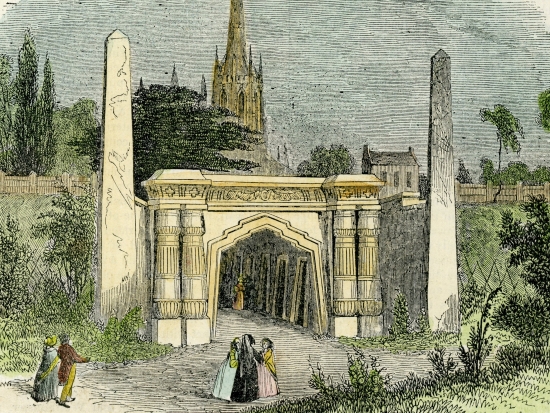
 
And when he visits Peter Cushing it is amidst the Gothic splendour of Oakley Court, just outside Windsor (a location most famous for its appearances in a number of Hammer films):

Here's a similar view from Oakley Court's website:


You can still see these statues outside the entrance to the hotel:


They Were Sisters (1945)
Dulcie Gray, Anne Crawford & Phyllis Calvert
They Were Sisters is the story of three sisters, the sensible one Lucy (Phyllis Calvert), the rather quiet one Charlotte (Dulcie Gray) and the bad girl Vera (Anne Crawford). Right from the opening scene we get to learn about their differing characters when we get to see them getting dressed. The film opens with a view of Crawford's legs as she fixes her stockings:
Anne Crawford

Anne Crawford
Then we are introduced to her sisters ... 
Anne Crawford & Dulcie Gray

Phyllis Calvert & Anne Crawford
... Gray's rather modest outfit and Calvert's sensible dressing gown are contrasted with Crawford's racier outfit to tell us all we need to know about their contrasting characters. It's a simple device that saves minutes of screen time meaning they hardly have to speak to introduce themselves. And, as regular readers of this blog will know, British film makers of the period loved a chance to get their female leads to parade around in their underwear.
 
Their contrasting characters are also reflected in their choice of husbands: Lucy marries a nice respectable architect (Peter Murray Hill, Calvert's real life husband) ...
Phyllis Calvert & Peter Murray-Hill
... whilst Vera marries Brian (Barry Livesey) ...
Barry Livesey & Anne Crawford
...who she doesn't love but who keeps her in a comfortable life so she can spend time with her various lovers:
Anne Crawford & Hugh Sinclair
However, the meek and mild Charlotte makes a rather poor choice and marries Geoffrey (James Mason) ...
James Mason

James Mason & Dulcie Gray
... a man who only wants her because he can exploit her good nature and enforce his iron will upon her. It's a terrible relationship that her sisters know will only lead to disaster and which soon sees her turning to drink:
Dulcie Gray
 
This being a Gainsborough film, with James Mason as the male lead, you know that things are going to turn out bad for someone. Of course, had Stewart Granger have been cast instead of Peter Murray-Hill then the script  would have needed to be re-written to allow Granger to confront Mason in an epic fight - that would probably have ended with them bare chested and dripping in blood - but no such luck. Instead, revenge for Mason's deeds comes in a quieter form.
 
It's hardly the most exciting film ever made but is entertaining in it's own way. In a curious casting choice, Pamela Kellino plays the daughter of Dulcie Gray and James Mason ...
James Mason & Pamela Kellino

James Mason, Pamela Kellino and Dulcie Gray
... this is despite Kellino being just one year younger than Gray and seven years younger than Mason. Not only that, but Kellino was actually married to Mason at the time. It is also worth noting that she was born Pamela Ostrer, her break into films no doubt coming from her family's ownership of Gainsborough Studios. She was the mother of Morgan Mason who married the pop singer Belinda Carlisle.
 
With the film starting in 1919, before the action moving on to the 1930s, it was interesting to see how the film costumed the male actors. Rather than attempting to dress them in period costume, for the scenes set in 1919 they are simply given 1940s suits but wear stiff collars and boater hats to give it a period flavour. In particular, the 1940s cut of the suit can be clearly seen in the broad, padded shoulders of Mason's suit:
Peter Murray Hill

Barry Livesey

James Mason

James Mason
 
P.S. Also look out for a very young Thorley Walters:
Thorley Walters
 
Currently available as part of the 'Best of British' DVD range:


Saturday, 4 April 2015

Take A Chance (1937)
 
Claude Hulbert

'Coming up on the outside it's number 8, Take a Chance ....'
This is one of those rather silly 1930s comedies which are hardly ever shown on television and, as such, are forgotten by most people. However, there's much to be said for not overly funny old comedies: they are short, they are great illustrations of the fashions and styles of the period and you don't have to concentrate too hard.
Oh, and also - of course - being a British comedy of the 1930s the female lead always has to make a brief appearance in her underwear:
Enid Stamp-Taylor
'Take is Chance' is the racehorse owned by Archie Burton (Henry Kendall) ...
Henry Kendall
... whose wife Cicely (Enid Stamp-Taylor) ...
Enid Stamp-Taylor
... is having an affair with Richard Carfax (Guy Middleton) ...
Guy Middleton
 
He's a rogue who uses information provided to Cicely to back Archie's horse. Once the information is out everyone else starts backing the horse, with the secret out Archie and his friend 'Blinkers' (Kynaston Reeves) ...
Kynaston Reeves & Henry Kendall
 
... decide to employ someone to investigate the 'leak'. Of course they choose Pallivant (Claude Hulbert) ...
Claude Hulbert
 
... who is simply an idiot. They describe him as a gent, but he's "broke to the wide" - whatever that means. Through a serious of ridiculous mishaps, including bookies, wide boys, car chases, and a pair of what appear to be lesbian garage owners (Binnie Hale & Gwen Farrar) ...
Gwen Farrar & Binnie Hale
... the day is saved.
 
But does that really matter? For me the film was more about observations, rather than the storyline. After all, it's a comedy, you know that the wide boys at the racing track aren't actually going to 'carve up' Claude Hulbert's face (as would probably have happened at a 1930s race meeting) and you know the Guy Middleton won't actually run off to Paris with Stamp-Taylor. It has to have a happy ending, so I concentrated on the fashions. For a start, look at Claude Hulbert's shoes. They are spectators/correspondents with Tarsal straps:
 
 
And you will note that all the bookies appear to wear shirts with tab-collars:


Although it's difficult to see, Henry Kendall's shirt has an interesting checked weave:
 
 
And the 'wide boys' at the races wear the most over-the-top outfits that immediately set them apart from the more sober suit wearing respectable men:
Wide Boys

Wide Boys

Wide Boys
Compare them to the more respectable gentlemen:
Henry Kendall & Kynaston Reeves
 
Guy Middleton's role is as one of those stock characters that were so-beloved of British cinema: the seemingly respectable gentleman charmer who cannot be trusted to keep his hands off other men's wives and who can certainly not be trusted not to cheat every man whose path he crosses. Yet at the end of the day he always loses and is shown up for what he really is. He is well-dressed, with a neatly clipped moustache and a flower in his lapel:
Guy Middleton
It's the type of role that was given to Terry-Thomas for much of his career. Did I say Terry-Thomas? Here he is, in an un-credited role, standing behind Middleton at the race meeting:
Terry-Thomas (centre) with Guy Middleton (right)
Also appearing is Bill Shine:
Bill Shine (left)
It's currently available as part of volume seven of the Ealing Rarities Collection: