Wednesday, 16 October 2013

Midshipman Easy (1935)
 

HMS Harpy
 
 
Carol Reed was, without doubt, one of the greats of British cinema and therefore one feels that there should be something positive to say about this, his first credited outing as a director.
 
Note my use of the word 'should'.
 
Truth be told, I'm not so sure. Adapted from a book by famed nautical author Captain Marryat, it's the story of rebellious teenager who goes to sea as a midshipman on a British warship. Unable to  curb his wayward ways he gets into all manner of scrapes: he neglects his duties and, ignoring orders, captures a Spanish merchant ship; goes ashore in Sicily, captures a legendary bandit, falls in love, then has to rescue his girlfriend from the clutches of the bandit after he escapes. All 'boys own' adventure story stuff.
 
But there's one problem: at the heart of the film is a love story between Midshipman Easy and the Spanish girl  Donna Agnes. Now, I have no problem with a bit of romance in the midst of an action story. Especially when the female in question is the rather lovely Margaret Lockwood ...
Margaret Lockwood
...aged 18, in only her fifth screen  appearance. I don't even mind that the lovers are a mismatched pair ...
 
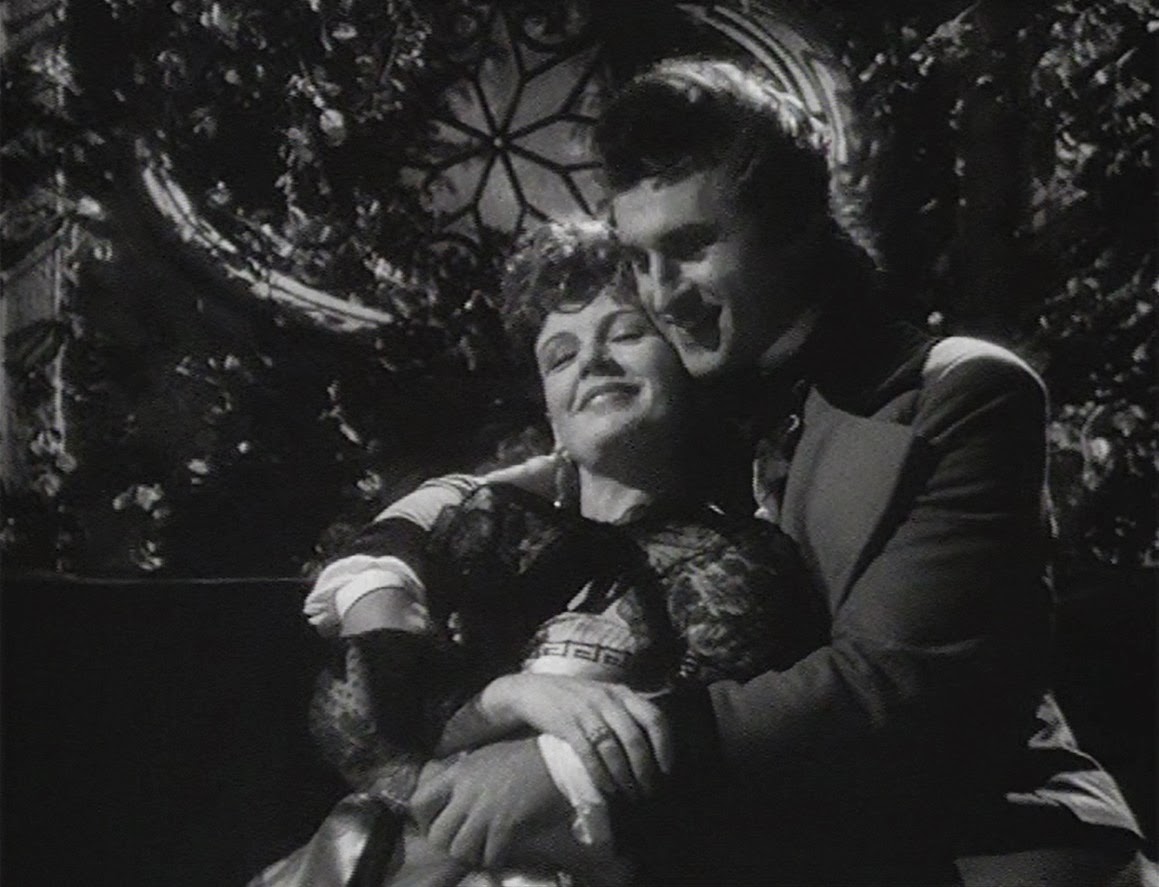
... But where I have a problem is her love interest: a certain fifteen year old Hughie Green:
 
Hughie Green
 
Yes, that's right: Hughie Green. And (those of you born before 1970 will understand) I mean that most sincerely folks! Hughie, the annoying presenter of Opportunity Knocks ... the Simon Cowell of the 1970s ... the father of Paula Yates. I could go on.


Yes, that Hughie Green - as Margaret Lockwood's boyfriend! My god, life really isn't fair.
 
Green & Lockwood

Green & Lockwood

Green & Lockwood
 

It didn't spoil the film, but I'll say it one more time: Hughie Green and Margaret Lockwood!!!
 
So what can I say on a positive point:
 
The story presents a few elements of nautical life, such as the violence of life at sea ...


... and seasickness ...
Robert Adams & Hughie Green
... we get to see Margaret Lockwood playing the guitar ...
Margaret Lockwood
... we get to see Hughie Green in drag ...
Hughie Green
 
... we get to laugh at the bandit, Don Silvio, as he protests that his portrait on the reward poster doesn't does his moustache justice ...
Dennis Wyndham
... but most rewarding of all: we get to see Hughie Green kneed in the groin!
Hughie Green & Dennis Wyndham

Hughie Green
 
I think I spent most of the 1970s wanting to do that - or at least see someone else doing it. Hughie, you got kneed in the nuts and spent your life getting your revenge by giving us the cultural giants of Peters & Lee, Paul Daniels, Bonnie Langford, Bobby Crush and Lena Zavaroni .... thanks mate!
 
On a positive point, it is available in a box set featuring The Big Blockade, The Four Just Men and Brief Ecstasy ... all of which are more than worth watching:


So buy the DVD, you'll enjoy the other films, just don't expect to be thrilled by Midshipman Easy.
 
Oh, and just in case you missed it ... Hughie Green is the romantic lead!!!!
Hughie Green


Monday, 7 October 2013

Get Carter (1971)
Michael Caine
Finally, I hear you say, he's reviewed a film that's in colour and doesn't star either Stewart Granger or Phyllis Calvert. But what is there to say about Get Carter that hasn't already be said? 
There are all the famous lines, the gritty period locations, the whole cool, iconic Michael Caine image.
I could write for pages on the contrast between the grim old Newcastle ...

.... and the modern, brutal style of the city as it is redevelops:


I could do that (studying how the modern city is clean and bright but empty and lifeless, in comparison to the old buildings and pubs which are so full of life).
I could ... but I'm not going to. Instead I'm going to look at wallpaper:
An attempt at sixties modern style at the bed and breakfast

An attempt at sixties modern style at the bed and breakfast

Dull floral paper in the bed and breakfast


1950s style paper in the Carter family home

What looks like it might be 1930s paper in the Carter family home

Faded paper in Carter's old family home


Grand paper for a grand house: Kinnear's living room


1940s/1950s style children's paper in Kinnear's house.
Even the porn set has interesting wallpaper
Why did I choose to paste photos of wallpaper? Because it's not often you see such a range of interior design hints all in one film.
One other thing to add:
Maybe it's just me, but I can never look at Michael Caine in this period ...
Michael Caine
... and not think of the 1970s Leeds Utd striker, Mick Jones:
Mick Jones


Sunday, 6 October 2013

The Lamp Still Burns (1943)
 
Rosamund Johns
 
 Here's a rather curious film: It is effectively a propaganda piece, made with the assistance of the Ministry of Health ...
 
... aimed at encouraging the modernisation of the nursing profession. Produced by Leslie Howard, who died before the film was completed, The Lamp Still Burns, tells the story of a young architect, Hilary Clarke (played by Rosamund Johns) ...
Rosamund Johns
... who witnesses an accident and decides that she should become a nurse.


However, following an explosion at a factory she meets factory owner/engineer Lawrence Rains (played by Stewart Granger) ...
Stewart Granger
... who she knew from her days as an architect, and the two promptly fall in love.
 
The love story is only really incidental to the main message: that nurses should not live cloistered lives, should be allowed the freedom to marry, be women with normal lives, and yet continue to be nurses. This conflict between the old and the new is shown from the opening scene when the audience is treated to the exterior of the Rains Engineering Works ...
... which is clean, bright and modern. This is in stark contrast to the interior of the hospital which is dark and forbidding, with strict rules that control the lives of the women who work within. Lawrence Rains is shown as a modern business owner, as comfortable on the factory floor in overalls, working closely with his engineers, as in the boardroom. Eventually it is he who supports the challenge to the rules that restrict the lives of the nurses, appearing before the hospital board to support Nurse Clarke after she faces disciplinary action for a number of offences including drinking on duty:
Rosamund Johns (centre) & Eric Micklewood (right)

Eric Micklewood (left) and Rosamund Johns (right)
What is strange is that the film is inconclusive: will Nurse Clarke be successful in controlling her instinct to confront authority; will she ever be free to marry Lawrence Rains?
 
The film has a sense of hopefulness. It digs beneath the harsh front of the senior nurses to show their humanity and is respectful of how they had subverted their femininity in pursuit of their careers. Yet there is a strong message that their world has passed: now is the era of strong women, who should be free to pursue their careers and the personal lives. That the film received the full support and cooperation of the Ministry of Health is an indication that the message was not a challenge to the authorities but a signal that those running the country were looking forward. It comes as no surprise that the film was released just one year on from the 'Beveridge Report' (to which members of the Ministry of Health had contributed) which set the foundations for the creation of the national health Service which revolutionised British health care forever. One cannot doubt that the film makers were making their own contribution towards the argument in favour of health reform.
 
Other things to note:
 
The film marked the first appearance of Joyce Grenfell (credited as Joyce Greenfell)in a full-length feature:
Joyce Grenfell

Rosamund Johns & Joyce Grenfell
She plays a serious character - a successful, young female doctor - a far cry from the scatty comedy character she is perhaps most famously associated with.
 
Also appearing are Leslie Dwyer (also in The Way Ahead, The Goose Steps Out and I See A Dark Stranger) and Wylie Watson (who also appeared in Brighton Rock, Whisky Galore and London Belongs to Me):
Wylie Watson (centre) and Leslie Dwyer (right)
It being a film made in the UK in the 1940s, John Laurie also appears:
John Laurie & Joan Maude
One of the senior nurses is played by Joan Maude ...
Joan Maude
... who later appeared as one of the members of the 'celestial court' in A Matter of Life and Death.
 
Another cast member if Margaret Vyness, the Australian actress who was the wife of Hugh Williams (and mother of the British actor Simon Williams who found fame in Upstairs Downstairs)
 
Margaret Vyness

Margaret Vyness
This is not a film that I would recommend to everyone, however for anyone interested in the social changes that took place in British society during the 1940s, or the background to the creation of the Welfare State, The Lamp Still Burns provides a fascinating insight into the role of the media in spreading the message in support of the campaign for reform.


Friday, 4 October 2013

More Fashion:
The 'British Warm' Overcoat

If the film makers of the mid 20th century needed to show that their character was a former army officer - ideally a retired major or colonel - there was one item of clothing that he would wear: the 'British Warm' overcoat.

Nothing says 'ex-officer' better than putting a man into a light brown double breasted coat, made from heavy Melton wool, complete with leather football buttons. Whether the officer is a fine upstanding pillar of the community or a rogue, the coat is his badge of rank (whether or not the rank is real).

So here goes:


Stewart Granger as 'Colonel' Adam Black in Adam & Evelyne


Stewart Granger in Adam & Evelyne

Terry-Thomas as a down-on-his-luck retired army officer, turned fur thief, in Make Mine Mink

Cecil Parker as 'Major Courtney' in The Ladykillers
Aubrey Dexter as 'The Major' in Saloon Bar (1940)


Michael Gwynne in Village of the Damned
And here's your author showing that you don't have to be a major (or even a colonel) to wear one!

And here, if you are interested, is a link to a page that tells you all about the history of the style and it's beginnings as a military greatcoat: Gentleman's Gazette.


The Magic Bow (1946)

Stewart Granger

When I sat down to watch this film, I was unconvinced that the world had ever really needed a Nicolo Paganini biopic. Now that I've seen it, I'm still not sure.
Was it a comedy? A drama? A serious study of a musician and his demons?
Phyllis Calvert & Stewart Granger
Or was it simply another chance for Gainsborough studios to let Stewart Granger, Phyllis Calvert and Jean Kent get out on set and have some fun? I suspect the latter. I mean, this was released in 1946. Did someone at Gainsborough sit down and think: War's over, let's let some culture loose on the world.
Ok, that's the negativity over with, let's get onto the good points:
1) Stewart Granger's hair is good for a laugh:
Stewart Granger

2) The relationship between Paganini and his manager (played by Cecil Parker): They are an odd couple who play it like a 'buddy movie'
Cecil Parker & Stewart Granger

Jean Kent, Cecil Parker & Stewart Granger
3) There are some good lines: At one point Paganini announces "I admire virtue in others." He dismisses other violinists with the line: "anyone who can in play in time and wear  a clean collar can lead an orchestra."  Paganini sums up the sense of the tortured genius with the words: "Poverty is a burden shared by many. Success must be carried alone."
There is a splendid line at one of his performances.... 
... when a woman turns to her neighbour and says: "Is he really in league with the devil?" her friend replies: "They say he is the devil."
Stewart Granger & Jean Kent
Anyone who has read this blog before might have guessed that at least one half of the blogging team is a bit of a fan of Jean Kent. So I was rather pleased with Granger's finest line of the film, telling her:
"You are a hussy, but a very nice hussy."
But my favourite line comes courtesy of Cecil parker. When he hears that Paganini is to be knighted by the Pope he exclaims: "I must be a better manager than I realised."
4) Oh, and did I mention Jean Kent's in it?
Jean Kent

Jean Kent